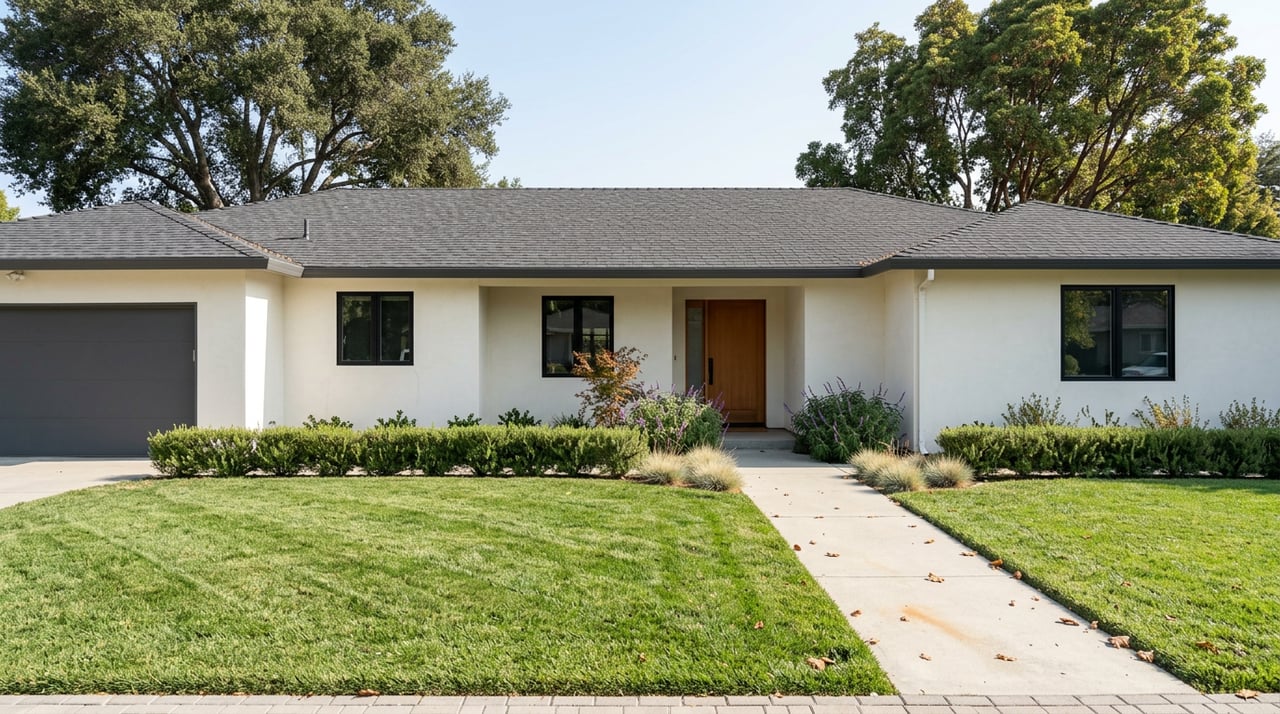
Why Los Altos Just Got More Expensive and Less Expensive at the Same Time
August 27, 2026
August 27, 2026
How does a city post a record price per square foot while the average sale price in its own priciest submarket falls nine percent in the same six months? That is exactly what happened in Los Altos in the first half of 2026, and the answer says more about how this market actually works than any single median-price headline can.
Most of what you will read about Los Altos home prices treats the market as one number. A median here, an average there, a price-per-square-foot figure stapled onto a listing description. But Los Altos does not price like one market. It prices like three or four overlapping ones, stacked by geography and by what a lot is actually allowed to hold. If you are comparing Los Altos to other Peninsula cities and trying to figure out what your money buys, that distinction matters more than the headline number.
Start with North Los Altos, the submarket closest to downtown and to the tech campuses that anchor so much of the buyer pool here. According to a semiannual sales breakdown published by Troyer & Cabot Group, a longtime local team, North Los Altos hit a record average price per square foot of $2,183 in the first half of 2026, up 6% from the same period in 2025. At the same time, the average sale price in that same submarket fell to $5,375,024, down 9% year over year.
Read those two numbers next to each other and they seem to contradict each other. They do not. What happened is a composition shift, not a cooling market. North Los Altos logged 15 sales at $6 million or more in the first half of the year, including 6 above $8 million, and the single highest sale anywhere in Los Altos during that window, at $9,555,000, closed in this same area. But the mix shifted toward fewer of the very top trophy sales compared to a year earlier, which pulled the average dollar figure down even as the per-square-foot value of what did sell kept climbing. Fewer $9 million estates changing hands does not mean buyers are paying less for square footage. It means the small number of transactions at the very top of the market moved the average without moving the underlying value of the space itself.
Zoom out to the whole city and the pattern still holds, just from a different angle. Los Altos logged 146 single-family home sales in the first half of 2026, up from 140 in the first half of 2025 and 123 in the first half of 2024. That is three straight years of rising transaction volume, which tells you inventory has been loosening after a long stretch of scarcity. More homes are changing hands than at any point in recent years, and the submarket commanding the highest per-square-foot pricing in the city just set a record anyway. A looser market and a record per-foot price are not supposed to happen together. In Los Altos, right now, they are.
Here is how the two submarkets compared over the same six months:
| Metric (1st half 2026) | North Los Altos | Citywide |
|---|---|---|
| Price per square foot | $2,183, a new record, +6% YoY | Not broken out here; varies by submarket |
| Average sale price | $5,375,024, -9% YoY | Trending with rising transaction volume |
| Single-family sales | Included the city's top sale at $9,555,000 | 146 sales, up from 140 (2025) and 123 (2024) |
If you are pricing your search off a single number pulled from a portal, this table is the reason that number keeps disagreeing with the next site you check. Every aggregator is quietly averaging across submarkets that do not behave the same way.
There is a second layer underneath the per-square-foot number, and it has nothing to do with buyer sentiment. It has to do with what the city will let you build.
Los Altos strictly limits commercial development and keeps a tight design-review process for residential projects, and that same discipline shapes what a lot is worth on the open market. Floor area ratio limits, setback rules, and daylight-plane restrictions define the maximum home size a given parcel can support, and Los Altos updated its tree protection ordinance in 2024, extending protection to any tree 12 inches or greater in diameter measured 48 inches above grade, with a lower 10-inch threshold for native species. Removing a protected tree without approval is a misdemeanor. None of that is abstract. It determines exactly how much house a builder can put on a given lot, which in turn determines what that lot is worth to a builder before a single wall goes up.
That is why, in a market like this one, an aging single-story ranch on a generous lot can be priced closer to what the land will support than to what the existing structure is actually worth. Builders do not think in terms of replacement cost minus depreciation. They think in terms of buildable envelope and end value. A property with a straightforward, ministerial approval path is worth more to a builder than an identical lot facing a discretionary variance, even if the houses sitting on them look the same today.
This is the piece that a raw price-per-square-foot figure hides. Some share of what is closing at record per-foot pricing right now is not really a house sale. It is a land sale wearing a house's address, and the eventual buyer is pricing what can replace the structure, not the structure itself.
For anyone weighing whether to update an existing Los Altos home or tear down and start over, the math has a rough industry threshold: when a full-scope renovation costs more than 60 to 70 percent of what new construction would cost on the same footprint, rebuilding tends to be the better investment.
Run that against real numbers for a 2,200 square foot home. A gut renovation, one that takes the structure down to the studs and replaces plumbing, electrical, HVAC, and insulation, typically runs $715,000 to $935,000. A new build of the same size runs $770,000 to $1,320,000 or more, depending on finish level and site conditions. Once renovation costs climb into that upper range, the gap between fixing up and starting over narrows fast, and foundation condition often ends up being the deciding factor. Post-and-beam framing, aging galvanized plumbing, and asbestos or lead paint common in homes from the 1950s through 1970s all push the renovation number higher and the rebuild case stronger.
None of this is a decision to make on instinct. City permit review for residential projects typically takes four to eight weeks before construction even starts, and a sale or substantial new construction can trigger a property tax reassessment under California rules. If you are evaluating a Los Altos property with redevelopment potential, current planning activity across the city is public record, and the city's own project list is worth a look before you assume a lot's zoning matches its listing description.
If you are cross-shopping Los Altos against other mid-Peninsula cities, the record price-per-square-foot figure is not telling you Los Altos is simply "more expensive now than before" in a straight line. It is telling you that the value of buildable space here has never been higher, that the mix of what is selling shifts by submarket in ways a single citywide average will not show you, and that a meaningful slice of transactions are really about land economics shaped by tree ordinances and floor-area limits rather than the house currently standing on the lot.
That has a practical implication for a buyer. Two homes with similar list prices and similar square footage can represent completely different bets, one on a finished, move-in-ready structure, the other on what a future buyer will be able to build once the current house comes down. Knowing which one you are looking at before you write an offer changes both your number and your timeline.
Does a falling average price mean it is a better time to buy in Los Altos? Not necessarily. A falling average in a submarket like North Los Altos reflected fewer ultra-high sales, not softer demand for typical homes. Price per square foot in that same submarket hit a record in the same period.
Is price per square foot the same across all of Los Altos? No. North Los Altos posted a record $2,183 per square foot in the first half of 2026, a figure specific to that submarket. Submarket location changes the math more than most buyers expect, which is why a single citywide number rarely tells you what a specific street will actually cost.
If I buy an older home planning to rebuild, what should I check first? Confirm whether any trees on the lot are protected under the city's 2024 ordinance, review the floor area ratio and setback limits for the parcel, and get a clear read on foundation condition before comparing renovation cost to new construction cost.
If you are trying to figure out what a specific Los Altos property is really priced on, the structure in front of you or the lot underneath it, that is exactly the kind of read that benefits from a second set of eyes before you write an offer. Nisha Sharma works this market submarket by submarket, not headline by headline. Reach out to request a private consultation and home valuation before your next move.
Whether you are buying or selling a home. I'm here to help.
Get In Touch With Nisha To Learn More
Nisha Sharma
[email protected]
(650) 492-9263
CA DRE# 01746077
161 S. San Antonio Rd. Los Altos, CA 94022