Los Altos Hills vs Los Altos: Which Home Base Fits?
June 11, 2026
June 11, 2026
Trying to choose between Los Altos Hills and Los Altos for your next home? It is a common question for buyers who want a Los Altos address but need to balance privacy, convenience, lot size, and day-to-day lifestyle. The good news is that both communities sit in the same broader local K-12 ecosystem and both are firmly in the luxury price tier, but they live very differently once you look past the map. Here is how to compare them with confidence. Let’s dive in.
The clearest difference is how each place is built. Los Altos Hills is a lower-density, semi-rural residential community with large lots and open space. Los Altos is a more traditional city pattern with neighborhoods, shopping areas, and a broader mix of land uses.
That difference shapes almost everything else, from how private your home feels to how easy it is to run errands. If you know which lifestyle matters more to you, your decision often becomes much simpler.
Los Altos Hills has about 8,435 residents across 9.03 square miles, with a population density of 940.2 people per square mile. It also has a 93.4% owner-occupied rate and an average commute of 29.2 minutes. Median household income is reported at $250,000+, with per-capita income of $165,337.
The town describes itself as a residential, semi-rural community. Its planning documents state that there are no commercial or industrial uses within town limits, and the R-A zone is built around a 1-acre minimum lot size with one single-family dwelling per parcel. The town is also described as almost fully developed, with future change expected to come mainly through infill, redevelopment, ADUs, JADUs, and SB 9 units.
Los Altos has about 30,864 residents across 6.54 square miles, with a population density of 4,835.6 people per square mile. It has an 81.7% owner-occupied rate and an average commute of 22.3 minutes. Median household income is also reported at $250,000+, with per-capita income of $149,247.
The city has a broader land-use framework than Los Altos Hills. Its GIS and housing materials include several single-family designations, low-density and medium-density multifamily housing, senior housing, mixed-use possibilities, and commercial areas. Like Los Altos Hills, it is built out, but its future housing strategy relies more on rezoning and reuse of existing sites.
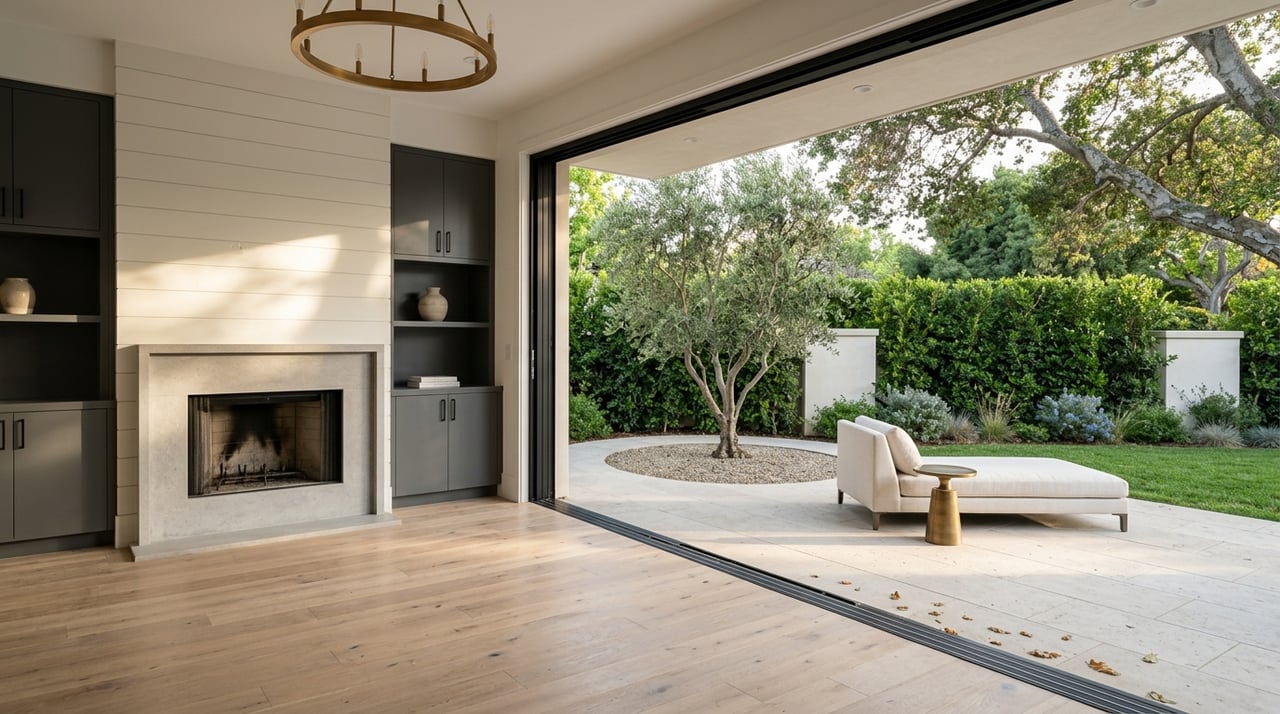
If privacy is high on your list, Los Altos Hills usually stands out. Its lower density, 1-acre minimum lot standard, and lack of commercial or industrial uses create a more secluded residential feel. For many buyers, that translates into more breathing room and a stronger sense of separation from nearby activity.
Los Altos can still offer quiet residential streets, but the overall city is much denser. In fact, it is about 5.1 times as dense as Los Altos Hills based on current Census figures. If you want a home environment that feels more tucked away, Los Altos Hills is often the more natural fit.
For lot size, Los Altos Hills is the clearer answer. The town’s residential zoning centers on a 1-acre minimum lot size, which is one of the most important facts to know if outdoor space matters to you. Buyers who want more separation between homes, more yard area, or room for a more expansive single-family property often start there.
Los Altos offers a wider range of residential formats and densities. That variety can be a strength if you want more options, but if your top priority is a large parcel, Los Altos Hills has the more defined large-lot identity.
This is where Los Altos often has the edge. The city lists seven shopping sectors, including Downtown Los Altos, Loyola Corners, Rancho Shopping Center, Village Court, Woodland Plaza, Foothill Crossing, and El Camino Real. That gives you more built-in convenience for shopping, dining, and quick local trips.
Los Altos Hills follows a different pattern. The town emphasizes its residential setting and pathway network, and it maintains more than 86 miles of pathways that support circulation, recreation, emergency access, and preservation of open character. That can be a real lifestyle benefit, but for errands and downtown-style convenience, Los Altos is generally the easier place to live.
Commute time may matter more than you think, especially if you are balancing office days, school schedules, or frequent travel across Silicon Valley. Census data shows an average commute of 29.2 minutes in Los Altos Hills and 22.3 minutes in Los Altos.
That means Los Altos has the shorter average commute by about 6.9 minutes. While your actual drive will depend on your destination and schedule, the broader pattern suggests that Los Altos may work better for buyers who want to trim everyday travel time.
Another major difference is housing variety. Los Altos has a broader mix of residential categories and commercial areas, which can support a wider range of home types and buyer preferences. If you want more flexibility in style, density, or setting, Los Altos tends to provide more options.
Los Altos Hills is more focused. Its identity is centered on detached single-family living on larger parcels in a low-density environment. That clarity is a benefit for buyers who know exactly what they want, but it can mean fewer choices if you are looking for a broader menu of property types.
For many buyers, schools are part of the conversation when comparing these two communities. According to Los Altos School District, its schools are situated in Los Altos, Los Altos Hills, Mountain View, and Palo Alto, while MVLA states that it serves Mountain View, Los Altos, and Los Altos Hills.
The important takeaway is that both communities sit within the same broader local K-12 ecosystem that buyers often evaluate during a home search. That means your decision will often come down less to city name alone and more to the specific property, location, and lifestyle tradeoffs that matter most to your household.
| Category | Los Altos Hills | Los Altos |
|---|---|---|
| Overall feel | Semi-rural, lower density, more secluded | Village-like, more connected, more active |
| Population density | 940.2 people per sq. mile | 4,835.6 people per sq. mile |
| Lot pattern | 1-acre minimum lots in key residential zoning | Broader mix of residential densities |
| Commercial areas | No commercial or industrial uses within town limits | Seven shopping sectors and downtown-style convenience |
| Average commute | 29.2 minutes | 22.3 minutes |
| Housing variety | Primarily detached single-family focus | Wider range of housing and land uses |
Los Altos Hills often appeals to buyers who care most about privacy, larger parcels, and a quieter residential setting. If you picture a home that feels removed from daily bustle, with more land and a more open setting, this market tends to match that goal well.
It can also be a strong fit if you are focused on long-term single-family ownership in a community with a very defined character. Because the town is almost fully developed and organized around low-density residential use, buyers often value its consistency just as much as its scenery and space.
Los Altos often appeals to buyers who want convenience, a town-center feel, and more housing flexibility. If your ideal lifestyle includes easier errands, nearby shopping districts, and a more connected neighborhood pattern, Los Altos may feel more practical.
It can also work well for buyers who want access to a broader range of home settings within the same city. That does not mean every part of Los Altos feels busy, but it does mean the city offers more variety in how you can live day to day.
Neither city is universally better. The better choice is the one that fits how you want to live. If your top priorities are land, privacy, and a more secluded atmosphere, Los Altos Hills usually rises to the top. If you value convenience, shorter average commutes, and a broader mix of housing and local amenities, Los Altos often makes more sense.
When you compare homes in this price tier, small lifestyle details matter. Street pattern, lot size, access to errands, and the overall feel of a neighborhood can shape your experience just as much as square footage or finishes. That is why a side-by-side, property-specific approach is so important.
If you are weighing Los Altos Hills against Los Altos, working with a local advisor can help you move beyond broad impressions and focus on the homes, streets, and lifestyle patterns that best match your goals. For tailored guidance on single-family and luxury homes in these communities, connect with Nisha Sharma.
Whether you are buying or selling a home. I'm here to help.
Get In Touch With Nisha To Learn More
Nisha Sharma
[email protected]
(650) 492-9263
CA DRE# 01746077
161 S. San Antonio Rd. Los Altos, CA 94022